

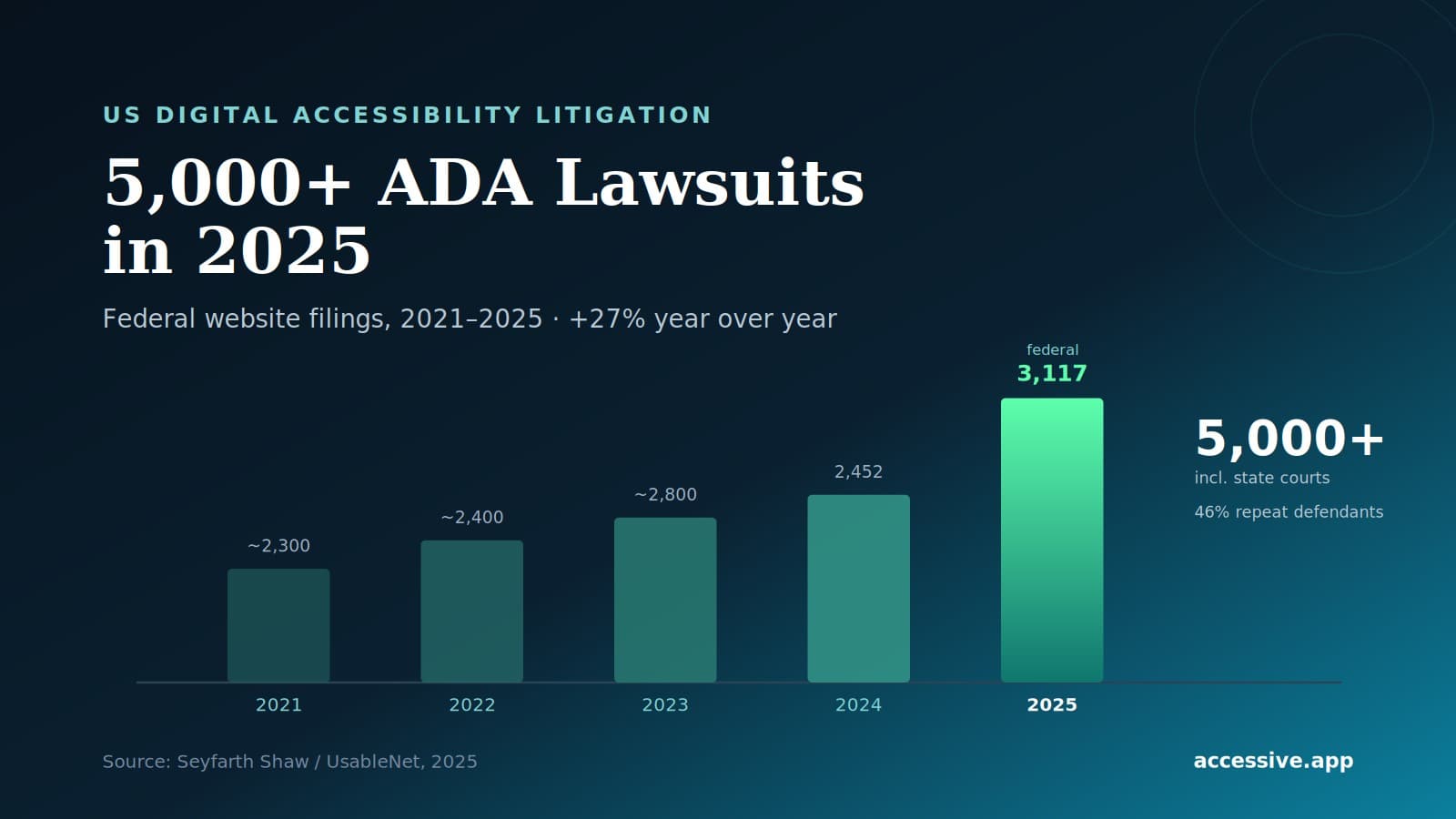

Digital accessibility lawsuits crossed 5,000 in 2025. Nearly half of defendants had been sued before, and most were businesses under $25M in revenue. Here's what the litigation data actually means for your risk.
Digital accessibility lawsuits crossed 5,000 in 2025 — and the number alone undersells the story. The more useful question isn't "how many," it's "who, why, and what does it mean for a business like mine?" Because the businesses getting sued in 2025 are, overwhelmingly, not the national brands most owners picture when they think about ADA lawsuits. They're small and mid-sized companies with ordinary websites and a handful of fixable accessibility barriers.
This breakdown walks through the 2025 ADA website lawsuit numbers, what they reveal about how plaintiffs choose targets, which industries and states carry the most risk, and the practical steps that actually reduce your exposure.
Litigation at scale: the 2025 numbers
Start with the headline figures, verified across the major litigation trackers:
- 3,117 website accessibility lawsuits were filed in federal court in 2025 — a 27% increase over 2024.
- Including state-court cases, total digital accessibility lawsuits topped 5,000 for the year.
- Website cases now make up roughly 36% of all federal ADA Title III lawsuits, up from 28% the year before.
- Total federal ADA Title III filings hit 8,667 in 2025 — about three times the 2013 level.
The trend line matters more than any single number. Website accessibility litigation has risen essentially every year since 2017, and 2025 set the modern record. This is not a temporary spike tied to one ruling or one plaintiff — it's a structural shift in how ADA Title III is enforced, driven by the simple fact that a website is now the front door of almost every business.
Who actually gets sued — and why it's probably you
Here's the finding that reframes the entire risk picture: the majority of 2025 defendants were businesses with under $25 million in annual revenue. There is no small-business exemption under ADA Title III. A boutique online store, a regional restaurant group, a local clinic — all are squarely in scope, and all are being sued.
The reason is mechanical, not moral. Plaintiff firms increasingly use automated tools to scan large numbers of sites for the same handful of detectable violations, then file at volume. A small site with a missing form label is just as flaggable as a large one — and smaller businesses are less likely to have already remediated, making them easier targets.
The repeat-defendant problem
The single most important pattern for any business that has already dealt with a complaint: 46% of 2025 federal cases involved repeat defendants. Of the 5,000+ total filings, roughly 1,427 targeted companies that had already faced a web accessibility claim.
The cycle is consistent — a settlement, a limited or cosmetic fix, a new plaintiff, and another filing, often within months. Plaintiff firms maintain databases of companies that settled without fixing their underlying code and revisit them deliberately. One lawsuit materially raises the odds of a second one unless remediation is thorough and stays thorough. This is the data-backed case against treating accessibility as a one-time project.
A website is now the front door of almost every business — and in 2025, it's the front door plaintiffs walk through.
Which industries are hit hardest
ADA website litigation concentrates in consumer-facing, transaction-heavy sectors where accessibility barriers directly block a purchase:
- Restaurants and food service were the single most-targeted industry, accounting for roughly 35% of filings in parts of 2025 — an enormous year-over-year jump, driven by inaccessible online menus, ordering, and reservation flows.
- Fashion and apparel e-commerce came next, around a quarter of filings.
- Combined, e-commerce and retail accounted for over 70% of all digital accessibility lawsuits — the most heavily targeted category by a wide margin, because checkout flows, product filters, and carousels are dense with the interactive elements that fail WCAG checks.
- Healthcare is the fastest-growing category by percentage, climbing ahead of HHS Section 504 obligations.
If your business takes orders, bookings, or payments online, you're in the highest-risk group — not because you've done anything wrong, but because transactional sites give plaintiffs the strongest standing argument.
Where the lawsuits are filed
Litigation is also geographically concentrated. New York, Florida, California, and Illinois together account for roughly two-thirds of all federal ADA web accessibility filings. New York leads by volume, driven by state human-rights provisions that add remedies on top of the federal ADA. Illinois saw explosive growth as plaintiff firms expanded into new jurisdictions. But "all other states" also rose sharply in 2025 — the litigation is spreading beyond the traditional hotspots, not staying contained in them.
The six issues behind most of the exposure
The encouraging part of the data: the violations driving litigation are remarkably consistent and largely fixable. Industry analysis attributes the overwhelming majority of WCAG failures to a short list:
- Low-contrast text
- Missing alternative text on images
- Missing form input labels
- Empty links
- Empty buttons
- Missing document language
Together, these account for the bulk of all automated WCAG failures across the web — and they map directly to the violations cited in complaint after complaint. The same things that get you sued are the same things a competent WCAG 2.2 AA remediation fixes first.
What it costs to get this wrong
Settlement economics explain why this is a volume business for plaintiff firms. Demand-letter settlements commonly range from a few thousand to around $25,000; out-of-court settlements average in the tens of thousands; court judgments run higher, and class actions can reach into the millions. Even successfully defending a case with no damages typically costs five to six figures in legal fees. Across the industry, digital accessibility litigation has produced hundreds of millions of dollars in settlements and damages since 2019.
The math is simple: proactive remediation is almost always cheaper than a single settlement, and dramatically cheaper than a second lawsuit.
Why overlays don't solve it
A predictable response to these numbers is to install an accessibility overlay widget and move on. The data says that doesn't work: roughly 22% of 2025 ADA website lawsuits targeted sites that already had an overlay installed. The FTC underscored the point with a $1 million action against an overlay vendor for misrepresenting its product as guaranteed ADA compliance. Overlays don't fix the underlying code, and plaintiffs' testers — often using the same assistive technology real users rely on — see straight through them. Durable protection comes from code-level remediation, not a script in the footer.
What to do with these numbers
The 2025 data points to a clear, practical playbook:
- Baseline your site. Run a thorough WCAG 2.2 AA scan and find out where you actually stand — most owners are surprised.
- Fix the high-frequency issues first. Contrast, alt text, form labels, links, buttons, document language — the six that drive most exposure.
- Remediate at the code level, not with an overlay. It's the only kind of fix that survives a plaintiff's tester.
- Monitor continuously. A one-time fix goes stale on your next deploy; ongoing monitoring keeps a time-stamped audit trail that demonstrates a good-faith remediation practice.
- Publish an accessibility statement with a real feedback channel — expected, and a visible good-faith signal.
The bottom line
5,000+ lawsuits in 2025 isn't an abstract industry statistic — it's a map of where risk now lives, and it points squarely at ordinary, transaction-driven small and mid-sized businesses. The defendants who avoid the second lawsuit aren't the lucky ones; they're the ones who treated the first warning as a reason to fix their code properly and keep it fixed. If you sell, book, or take information online, the most useful thing you can do with these numbers is find out where your own site stands before a plaintiff's scanner does.
This article is for general information and is not legal advice. For guidance on your specific situation, consult a qualified attorney.