


The GSA's FY2025 assessment confirms the federal government is still missing its own Section 508 targets. For vendors selling to agencies, that's both a hard compliance gate and a real market opening.
On March 5, 2026, the General Services Administration published its FY2025 Governmentwide Section 508 Assessment — the annual report to Congress on how well federal agencies meet their own digital accessibility obligations. The headline finding is uncomfortable but clarifying: the federal government is still failing the standard it requires of itself.
For private companies, that's not just a government problem. If you sell software, hardware, or digital content to federal agencies — or want to — the Section 508 picture in this report is simultaneously a compliance gate you have to clear and a market opening you can move into. Here's the full breakdown.
What Section 508 actually requires
Section 508 of the Rehabilitation Act requires that federal agencies' information and communication technology (ICT) — websites, software, digital documents, hardware — be accessible to people with disabilities. In practice, the technical benchmark is WCAG 2.0 Level AA (and increasingly WCAG 2.1/2.2 AA in procurement language), the same family of success criteria that underpins ADA compliance.
The crucial point for vendors: Section 508 doesn't only bind agencies. It flows down through procurement. When an agency buys ICT, it's obligated to buy accessible ICT — which means your product's accessibility becomes a condition of the sale. That's why a credible VPAT (Voluntary Product Accessibility Template) is now table stakes for federal deals.
The FY2025 assessment: agencies are still failing
The numbers from the latest assessment, which drew on responses from 212 agencies and components, tell a consistent story.
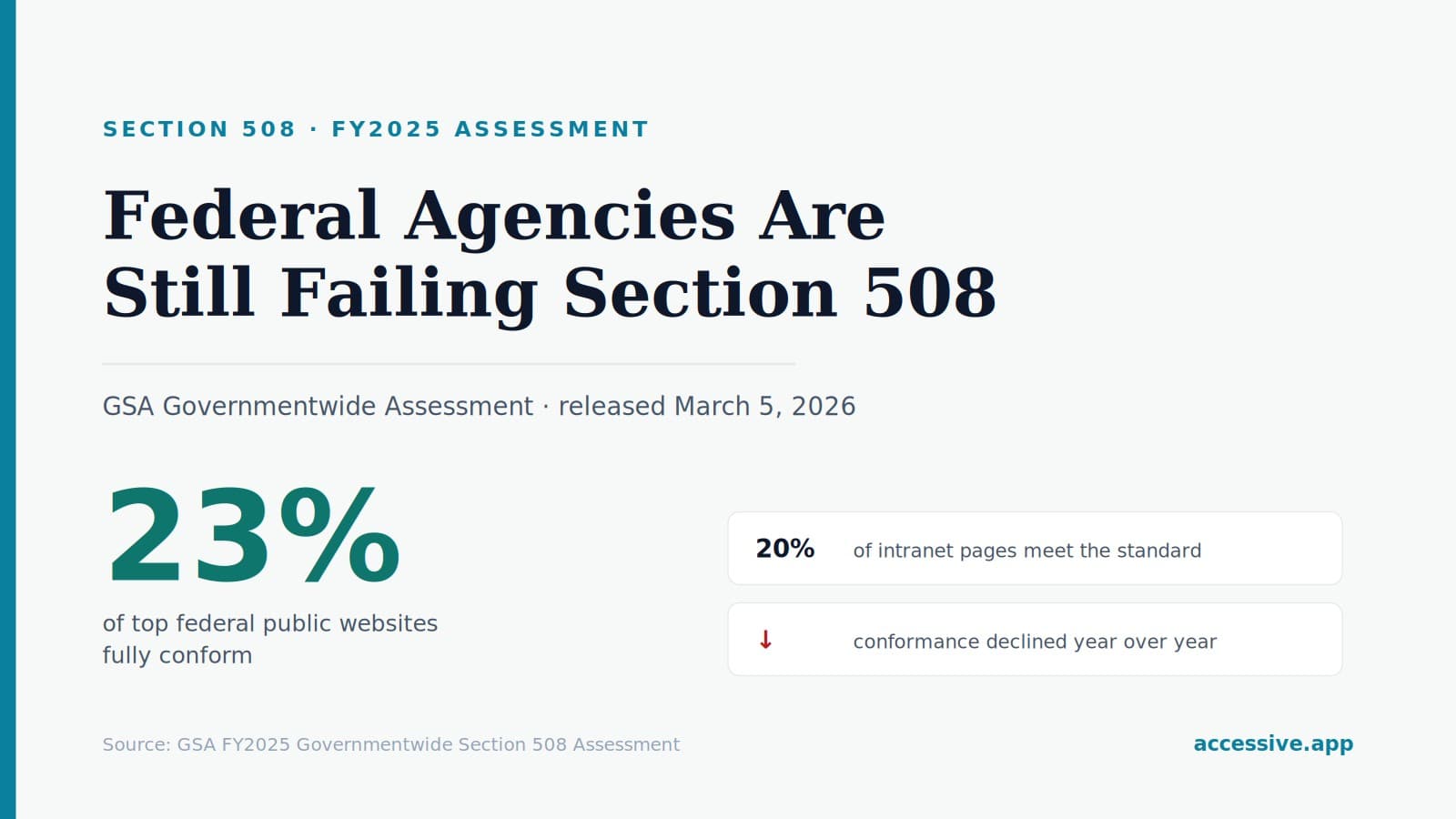
- Only about 23% of the most-visited public federal websites fully conform to Section 508 standards.
- Only about 20% of intranet pages meet all the standards.
- Governmentwide conformance actually declined year over year, even as agencies invested more in accessibility staffing and process.
- The report establishes a new baseline with revised assessment criteria, making FY2025 the reference point future progress will be measured against.
There's a genuine paradox in the data: program maturity rose — more agencies hired dedicated Section 508 program managers, improved testing, and tightened policy — while actual conformance slipped. In other words, agencies got better at managing accessibility while their digital estates got less conformant. That's the signature of a problem outpacing the resources thrown at it: federal digital content is growing and changing faster than agencies can remediate it.
Agencies got better at managing accessibility while their websites got less conformant — the work is outpacing the resources.
Why acquisition is the recurring failure point
Across multiple years of these assessments, the same weak spot keeps surfacing: acquisition. Agencies struggle to build accessibility requirements into how they buy technology, and they struggle to verify that what they bought is actually accessible. A procurement officer can require a VPAT, but evaluating whether that VPAT reflects reality — and whether the delivered product conforms — requires expertise many agencies don't have in-house.
This is exactly where the gap between "policy maturity" and "real conformance" lives. The rules are clearer than ever; the capacity to enforce them at the point of purchase is not. For vendors, that has two direct consequences.
What this means for vendors: the compliance gate
First, the hard part. Section 508 conformance is increasingly a non-negotiable gate on federal contracts. As agencies get more sophisticated about acquisition — partly in response to these very assessments — they are scrutinizing vendor accessibility more closely, not less. That means:
- You need an accurate, current VPAT 2.x for your product, grounded in real testing, not a marketing document.
- "We're working on accessibility" is no longer a winning answer in a federal RFP. Demonstrable WCAG 2.x AA conformance is.
- A VPAT that overstates conformance is a liability — agencies (and their independent testing) increasingly spot-check claims, and a product that fails verification can lose the contract and the relationship.
If you're selling to government and your accessibility story is thin, this assessment is a warning: the bar is rising, and the agencies are getting better at measuring it.
What this means for vendors: the market opportunity
Now the upside — and it's substantial. The same assessment that exposes agency failures also points to where federal money is about to flow. GSA has explicitly directed the Federal Acquisition Service to help agencies acquire accessibility-related products and services, and is building out a model often described as "Digital Accessibility as a Service" — consulting, testing, training, and remediation that smaller agencies can buy through a dedicated accessibility services purchasing channel.
Read that as a market signal. Agencies know they're behind, the assessment is forcing the issue with Congress watching, and many — especially smaller ones — lack the in-house capacity to fix it. That creates demand for exactly the kind of services accessibility vendors provide:
- Accessibility audits and conformance testing against Section 508 / WCAG.
- Remediation of websites, documents, and applications.
- VPAT preparation and validation.
- Continuous monitoring, so an agency's conformance doesn't decay between assessments — which the year-over-year decline shows is a real risk.
- Training for agency teams on accessible content and procurement.
For a vendor positioned in digital accessibility, the federal sector just became a clearer, Congressionally-pressured, budget-backed market.
How to position for the federal opportunity
If you want to turn this assessment into pipeline, a few concrete moves:
- Get your own house in order first. Have a real, tested VPAT for your product. You can't sell accessibility you can't demonstrate.
- Speak the procurement language. Reference Section 508, WCAG 2.x AA, and — where relevant — ISO/IEC 40500:2025 in your capability statements and RFP responses.
- Lead with verification, not promises. Agencies burned by overstated VPATs respond to evidence: audit reports, conformance data, monitoring dashboards.
- Offer the recurring piece. The conformance decline between assessments is the strongest argument for continuous monitoring — position it as the thing that keeps an agency conformant year-round, not just at audit time.
- Target the capacity gap. Smaller agencies and components are the least equipped and the most served by the new accessibility services channel.
The bottom line
The FY2025 Section 508 assessment is a rare document that's bad news and opportunity in the same breath. Federal agencies are still failing their own accessibility standards, conformance is sliding, and acquisition remains the weak link. For vendors, the takeaway is twofold: your product's Section 508 conformance is now a real gate on federal business, and the government's own struggle to keep up is opening a budget-backed market for the testing, remediation, and monitoring services that close the gap. The vendors who win federal accessibility work will be the ones who can prove conformance — their own and their clients' — not just claim it.
This article is for general information and is not legal advice. For guidance on your specific federal compliance obligations, consult a qualified attorney or accessibility professional.