

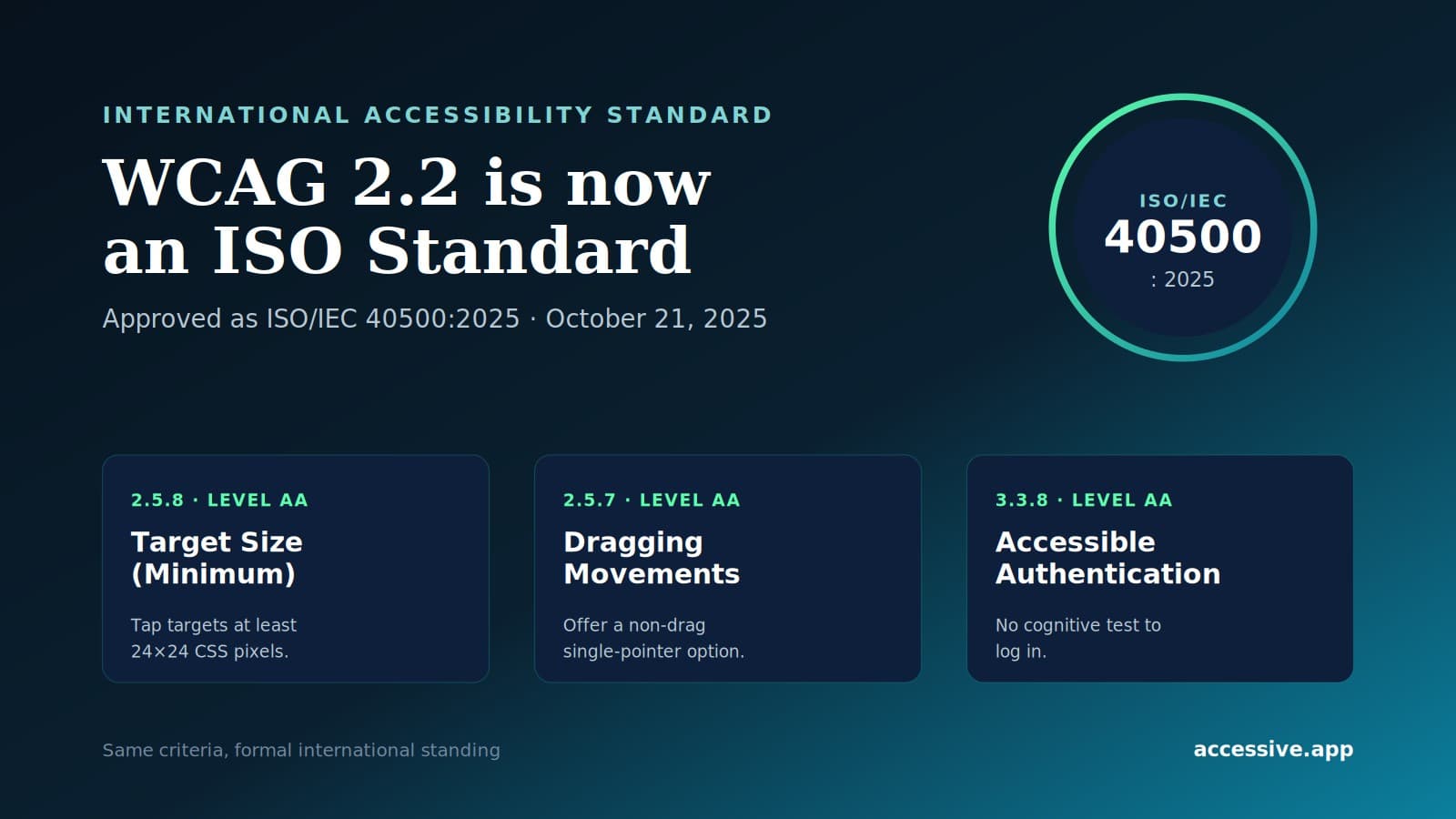

WCAG 2.2 was approved as ISO/IEC 40500:2025 in October 2025. The success criteria didn't change — but the legal and procurement weight behind them did. Here's what US teams should actually do about it.
On October 21, 2025, the Web Content Accessibility Guidelines (WCAG 2.2) were formally approved as an international standard: ISO/IEC 40500:2025. The W3C confirmed it directly. If you skim past that as bureaucratic housekeeping, you'll miss the part that actually affects your roadmap — because while the success criteria didn't change, the weight behind them did.
This is the rare standards update where "nothing technically changed" and "this matters a lot" are both true at the same time. Here's what the ISO approval really means for US teams, and the specific WCAG 2.2 criteria worth prioritizing now.
ISO alignment: what actually changed (and what didn't)
Let's separate the two halves cleanly, because conflating them is where teams go wrong.
What didn't change: the technical content. ISO/IEC 40500:2025 contains the same success criteria as the WCAG 2.2 recommendation W3C published in 2023. No new requirements were invented by the ISO process. If you were already conforming to WCAG 2.2 Level AA, you are already conforming to ISO/IEC 40500:2025. Nothing in your codebase needs to change because of the ISO number itself.
What did change: the standing. Until October 2025, WCAG existed as a W3C recommendation — widely respected, frequently referenced in law, but technically advisory. ISO approval elevates WCAG 2.2 from "recommendation" to "formal international standard." That distinction has real downstream consequences, especially in three areas.
1. Procurement and RFPs
Many public-sector and enterprise buyers — particularly in government, healthcare, and large corporations — only reference ISO standards in their procurement language. They can't easily cite a W3C recommendation in a contract, but they can absolutely cite an ISO number. With ISO/IEC 40500:2025 in hand, those buyers can now require WCAG 2.2 conformance directly in RFPs and vendor contracts. For any business that sells to the public sector or to enterprises, accessibility conformance just became a more concrete, more contractually enforceable line item — and a potential gate on winning the deal.
2. Legal and audit weight
In a compliance review, a courtroom, or an enforcement action, a formally published international standard carries more evidentiary weight than a non-ISO recommendation. ISO recognition removes ambiguity about which version of WCAG applies and gives auditors, regulators, and plaintiffs a single, internationally ratified reference point. For US litigation under the ADA, where courts have long looked to WCAG as the de facto technical benchmark, an ISO-ratified standard is a cleaner, harder-to-dispute reference.
3. Cross-border harmonization
ISO status makes it easier for regulations that map to ISO catalogues — including frameworks tied to the European Accessibility Act and EN 301 549 — to align around a single version of WCAG. For US teams that also serve EU customers, that convergence simplifies a previously messy multi-standard compliance picture into one coherent target.
The success criteria didn't change. What changed is that procurement teams, auditors, and regulators can now point to a single ISO number — and increasingly, they will.
Why US teams shouldn't treat this as "EU news"
It's tempting to file an ISO development under "international" and move on. That's a mistake for US organizations, for two concrete reasons.
First, US procurement increasingly mirrors ISO language. As enterprise and government buyers update their standard contract templates to cite ISO/IEC 40500:2025, US vendors who can't demonstrate WCAG 2.2 conformance will start losing deals on a compliance checkbox — regardless of where their customers are based.
Second, the ADA litigation environment rewards a defensible standard. With over 5,000 digital accessibility lawsuits filed in 2025 and courts already treating WCAG as the operative benchmark, being able to point to conformance with a formally ratified international standard — rather than "we follow some guidelines" — is a stronger position both in settlement negotiations and in demonstrating good-faith remediation.
Prioritize these success criteria first
WCAG 2.2 added nine new success criteria over WCAG 2.1, targeting gaps in keyboard focus, mobile and touch interaction, authentication, and cognitive support. You should plan to meet all of them at your conformance level — but three are worth moving to the front of the queue, because they address the most common real-world failures and are already surfacing in DOJ settlements and enforcement language.
Target Size (Minimum) — 2.5.8 (Level AA)
Interactive targets must be at least 24×24 CSS pixels, with limited exceptions. This catches the cramped, hard-to-tap buttons and links that fail constantly on mobile — close icons, pagination controls, icon-only buttons. It's high-impact and usually a straightforward CSS fix, which makes it one of the best early wins.
Dragging Movements — 2.5.7 (Level AA)
Any functionality that uses a dragging movement (sliders, drag-to-reorder, map panning, carousels) must offer a single-pointer alternative that doesn't require dragging. Users with motor impairments, and many touch users, can't reliably perform drag gestures. The fix is to add tap/click alternatives — buttons to step a slider, for example — alongside the drag interaction.
Accessible Authentication (Minimum) — 3.3.8 (Level AA)
Login and authentication can't require a cognitive function test — remembering or transcribing a one-time code, solving a puzzle CAPTCHA — unless an accessible alternative exists. This is increasingly cited because broken authentication blocks a user from the service entirely. Support password managers, copy-paste of one-time codes, and passkeys; avoid puzzle-based CAPTCHAs as the only path.
Your action checklist
The ISO approval is a prompt to tighten practice, not to panic. A practical sequence:
- Update your target to WCAG 2.2 AA if you're still building to 2.1 — it's backward-compatible, so 2.2 conformance also satisfies 2.1.
- Reference ISO/IEC 40500:2025 in your accessibility statement, audit reports, and any procurement responses — it's the language buyers and auditors now expect.
- Bake 2.5.8, 2.5.7, and 3.3.8 into your definition of done so new features can't reintroduce the failures these criteria target.
- Re-audit against the nine new 2.2 criteria specifically — teams that conformed to 2.1 often have gaps exactly here.
- Monitor continuously, so a future deploy doesn't silently break a criterion you just fixed. A one-time pass against 2.2 doesn't stay true on its own.
The bottom line
WCAG 2.2 becoming ISO/IEC 40500:2025 didn't add a single line to your remediation backlog — but it changed who can demand conformance and how much weight that demand carries. For US teams, the smart response is to treat WCAG 2.2 AA as the firm target it now formally is: update your definition of done, prioritize the newer criteria that keep showing up in settlements, cite the ISO number where it counts, and monitor so conformance holds. The standard got more authoritative. Your practice should get more deliberate to match.
This article is for general information and is not legal advice. For guidance on your specific obligations, consult a qualified attorney.