

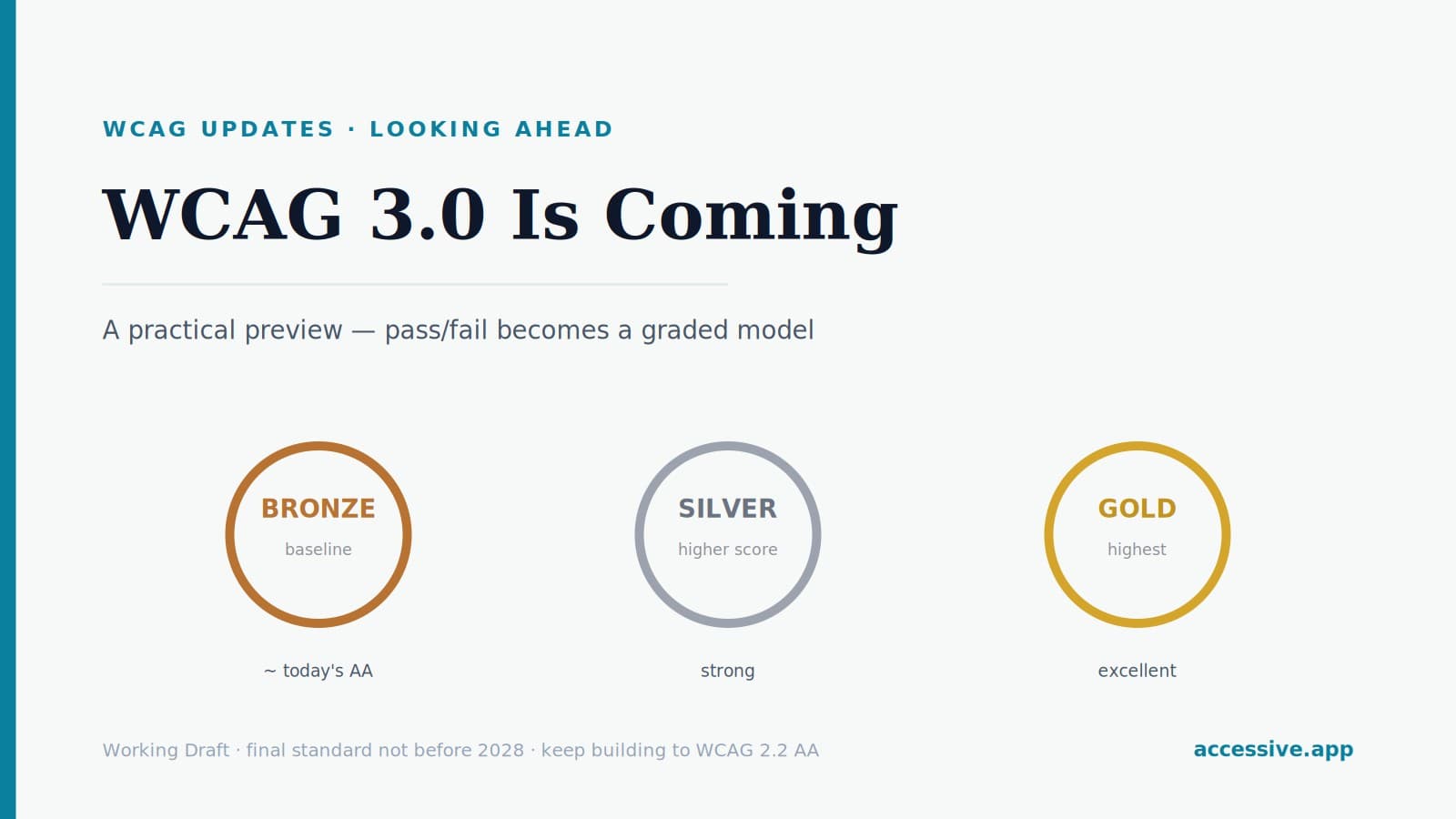

WCAG 3.0 reached a substantially complete draft in early 2026, replacing pass/fail with a bronze/silver/gold model and expanding to apps, XR, and cognitive needs. It won't be law for years — but here's why smart teams are preparing now.
There's a new accessibility standard on the horizon, and the headlines make it sound imminent: WCAG 3.0, with a completely reimagined model that replaces the familiar pass/fail grading. In January 2026, the W3C reached a "substantially complete" draft — a real milestone. But "substantially complete draft" and "the standard you must comply with" are very different things, and confusing them is the fastest way to waste a compliance budget.
Here's an honest, practical preview for US teams: what WCAG 3.0 actually changes, when it might matter legally, and what to do right now — which, spoiler, is not "wait for it."
What is changing
WCAG 3.0 isn't an incremental update like 2.0 → 2.1 → 2.2. Those added new success criteria to the same structure. WCAG 3.0 proposes a different model entirely. Four shifts stand out.
From pass/fail to bronze/silver/gold
Today's WCAG uses binary success criteria across Levels A, AA, and AAA — you meet a criterion or you don't. WCAG 3.0 proposes outcome-based scoring with three conformance tiers: Bronze, Silver, and Gold. Bronze is the baseline — roughly what Level AA aims at today. Silver and Gold require higher scores across more guidelines, representing genuinely strong accessibility rather than minimum-bar compliance.
The motivation is real: today's framework treats a barely-passing 4.51:1 contrast ratio the same as a crisp 10:1, which doesn't reflect actual user experience. A graded model captures that difference.
Outcome statements instead of success criteria
WCAG 3.0 replaces technical success criteria with plain-language outcome statements, with testing formally split into quantifiable and qualitative types. The goal is a standard that's easier to understand and that can describe accessibility needs that don't reduce neatly to a binary test.
Process "assertions"
The draft introduces assertions — documented statements about the processes an organization follows to create and maintain accessible content. This pushes accessibility beyond a one-time technical audit into organizational practice, conceptually similar to how the European Accessibility Act emphasizes embedding accessibility throughout an organization.
Broader scope
The standard's scope expands well beyond websites — to mobile apps, VR/XR, operating systems, authoring tools, and a much stronger focus on cognitive disabilities (clear language, consistent navigation, reduced cognitive load, anti-dark-pattern guidance). That's why the name shifts from "Web Content" to "W3C" Accessibility Guidelines.
The timeline: real, but not soon
This is where teams most often get the wrong idea, so be precise about it. WCAG 3.0 is still a Working Draft. The realistic timeline, based on the W3C's own roadmap:
- January 2026 — substantially complete draft (where we are).
- Q4 2027 — Candidate Recommendation targeted.
- 2028 at the earliest — final W3C Recommendation.
- 2029–2031 — realistic window for legal/regulatory adoption, since laws like Section 508 and EN 301 549 typically trail a new W3C Recommendation by one to three years.
And critically: when WCAG 3.0 is finalized, it will not immediately replace WCAG 2.2. The two are expected to coexist for years to allow a smooth transition. So for the foreseeable future, the operative legal benchmark for ADA, Section 508, and international compliance remains WCAG 2.1 / 2.2 Level AA.
WCAG 3.0 is a working draft, not a deadline. The standard that governs you today is still WCAG 2.2 AA.
Why you shouldn't wait for it
It's tempting to read "big new standard coming" as "pause and see what happens." That's the wrong move, for three reasons.
First, WCAG 3.0 isn't enforceable and won't be for years. Building toward a draft that's still subject to significant change is planning on sand. The proposed APCA contrast method, for instance, remains exploratory and isn't part of the normative draft — design to it now and you may be redoing work.
Second, WCAG 2.2 AA is what gets you sued or cleared today. With thousands of ADA website lawsuits filed annually, your live legal exposure is governed entirely by the current standard. Deferring 2.2 AA work to "wait for 3.0" leaves you exposed in the only timeframe that currently carries legal risk.
Third — and this is the reassuring part — doing WCAG 2.2 AA now is the best possible preparation for 3.0. A site that conforms to WCAG 2.2 Level AA will be broadly aligned with WCAG 3.0's Bronze tier, because Bronze encodes the same foundational requirements. The work isn't wasted when 3.0 arrives; it's the foundation 3.0 builds on.
What smart teams are doing now
Preparing for WCAG 3.0 doesn't mean building to it. It means getting into the posture that makes the eventual transition easy:
- Conform to WCAG 2.2 AA today. It's the legal standard and the Bronze foundation. This is 95% of "preparing for 3.0."
- Start documenting your process. WCAG 3.0's assertions reward organizations that can show how they maintain accessibility — testing cadence, ownership, remediation records. A continuous-monitoring audit trail is exactly this kind of evidence, and it's useful today regardless of 3.0.
- Think beyond the website. If you ship mobile apps or any emerging-tech surfaces, start treating their accessibility as in-scope — that's where 3.0 expands, and where many teams have the biggest gaps.
- Invest in cognitive accessibility. Clear language, consistent navigation, and avoiding dark patterns improve outcomes for real users now and anticipate a major 3.0 emphasis.
- Don't chase exploratory pieces. Skip non-normative proposals (like APCA) until they're settled. Build to the stable standard; watch the draft.
The bottom line
WCAG 3.0 is a genuinely significant rethink of how digital accessibility is measured — bronze/silver/gold instead of pass/fail, outcomes instead of criteria, process assertions, and a scope that finally reaches apps, XR, and cognitive needs. But it's a working draft on a multi-year track: Candidate Recommendation around Q4 2027, final standard no earlier than 2028, legal adoption likely 2029–2031, and coexistence with WCAG 2.2 even then. The smart move for US compliance teams isn't to wait — it's to nail WCAG 2.2 AA now, document your process, and broaden your scope. Do that, and WCAG 3.0 won't be a scramble when it lands. It'll be a tier you've already built the foundation for.
This article is for general information and is not legal advice. For guidance on your specific obligations, consult a qualified attorney or accessibility professional.