


The April 2026 ADA Title II deadline was extended at the last minute — but the obligation didn't go away. Here's the current, verified timeline for every US digital accessibility deadline, and what to do now.
If you planned your compliance roadmap around an April 2026 ADA deadline, the ground just shifted under you — twice. In the span of three weeks, both of the major US digital accessibility deadlines that were set to land in 2026 were extended by a full year. That's the headline. The more important point sits underneath it: the extension changed the dates, not the duty. The legal obligation to make digital services accessible never paused, and for private businesses, nothing was extended at all.
This guide lays out the current, verified timeline for every major US digital accessibility deadline — DOJ ADA Title II, HHS Section 504, and the ongoing ADA Title III litigation risk that applies to everyone — and what to actually do between now and your real deadline.
What changed in April and May 2026
For most of 2025, two deadlines dominated every public-sector and healthcare compliance roadmap: a DOJ ADA Title II deadline in April 2026 and an HHS Section 504 deadline in May 2026. Both have now been pushed back.
On April 20, 2026, the Department of Justice published an Interim Final Rule extending the Title II web accessibility compliance deadlines by one year. On May 7, 2026, HHS followed with a parallel extension of its Section 504 deadlines, explicitly to align with the DOJ's move. In both cases, the agencies cited the large number of covered entities — community health centers, hospitals, smaller municipalities — that reported they could not realistically meet the original dates.
Here's the part that matters for planning: the substantive requirements are unchanged. The technical standard remains WCAG 2.1 Level AA. The scope still covers websites, mobile apps, and (for HHS) kiosks, including services delivered through third-party vendors. Only the timing moved.
The current ADA & Section 504 deadline timeline
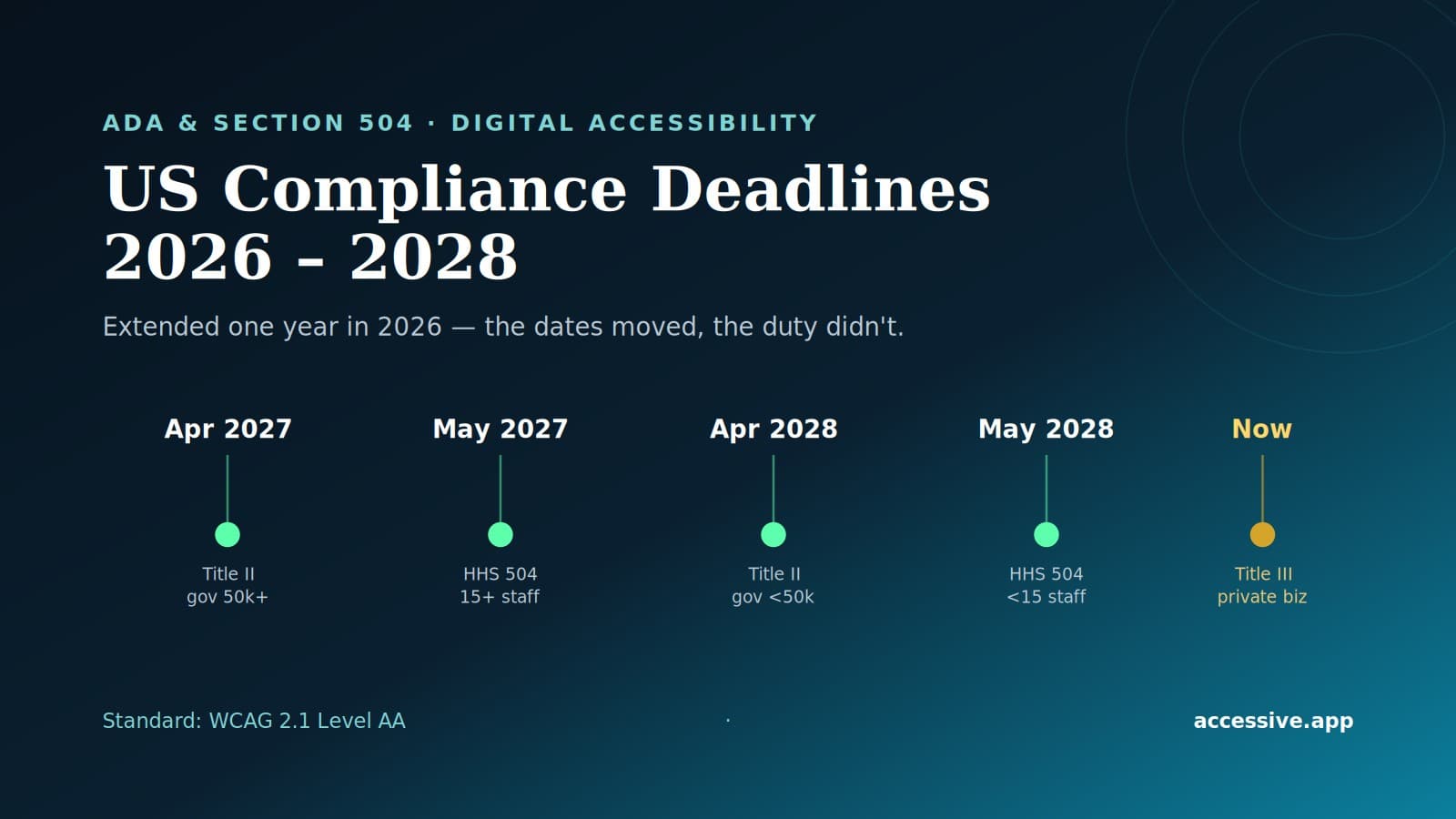
| Rule | Who it covers | Deadline | Standard |
|---|---|---|---|
| DOJ ADA Title II | State/local governments serving 50,000+ | April 26, 2027 | WCAG 2.1 AA |
| DOJ ADA Title II | Public entities under 50,000 + special districts | April 26, 2028 | WCAG 2.1 AA |
| HHS Section 504 | HHS-funded recipients with 15+ employees | May 11, 2027 | WCAG 2.1 AA |
| HHS Section 504 | HHS-funded recipients with under 15 employees | May 10, 2028 | WCAG 2.1 AA |
| ADA Title III | Private businesses open to the public | No deadline — already enforceable | WCAG 2.x AA (de facto) |
The last row is the one most organizations miss, and it's the most important.
Why "extended" does not mean "relax"
It's tempting to read a one-year extension as a year off. That reading is a mistake, for three concrete reasons.
1. The obligation never paused
Both agencies were explicit: the interim final rules change compliance dates, not the underlying anti-discrimination duty. Section 504's prohibition on disability-based discrimination in federally funded programs remains in full force today. ADA Title II's general nondiscrimination mandate predates the web rule entirely. An extension of the technical conformance deadline is not a suspension of the legal requirement to provide access.
2. The work takes longer than the extension
Remediating a large government or healthcare web presence — often hundreds of templates, thousands of PDFs, multiple third-party systems — is a multi-quarter program, not a sprint. The agencies extended the deadline precisely because entities reported the work couldn't be done in time. If it couldn't be done by April 2026, an extra twelve months is a window to execute, not to wait. Organizations that treat 2027 as "later" will arrive at 2027 in exactly the position that made 2026 impossible.
3. Private businesses got nothing
The DOJ and HHS extensions apply only to public entities (Title II) and HHS-funded recipients (Section 504). If you're a private business open to the public — a retailer, a restaurant, a hotel, a private clinic that doesn't take HHS funding — none of this applies to you. You're governed by ADA Title III, which has no compliance deadline because it's already enforceable, and has been for years.
The ADA Title III reality: no deadline, constant risk
While public entities watch a 2027 calendar, private businesses face something with no calendar at all: private litigation that's already happening at record volume.
In 2025, plaintiffs filed 3,117 website accessibility lawsuits in federal court — a 27% increase over 2024 — and total digital accessibility filings topped 5,000 when state courts are included. Website cases now account for roughly 36% of all federal ADA Title III lawsuits, up from 28% the year before.
And the targets are increasingly repeat defendants: 46% of 2025 federal cases involved companies that had already been sued at least once. Plaintiff firms maintain databases of businesses that settled without fully fixing their code, and they come back. For a private business, the operative deadline isn't a date on a DOJ calendar — it's the day a demand letter arrives.
An extension of the conformance deadline is not a suspension of the obligation. The duty to provide access never paused.
Who is actually covered? A quick self-check
- State or local government (city, county, school district, public university, court): ADA Title II. Deadline April 2027 or April 2028 by population.
- Healthcare or social-service organization that receives HHS funding (hospital, clinic, community health center, anything taking Medicare/Medicaid): HHS Section 504. Deadline May 2027 or May 2028 by employee count.
- Both (e.g. a county hospital): you're dual-covered — meet the earlier of the two applicable dates, though the underlying remediation work is the same.
- Private business open to the public: ADA Title III. No deadline, already enforceable, actively litigated.
If you're not sure which bucket you're in, that's the first thing to resolve with counsel — it determines your real timeline.
Your action checklist — what to do now
The extension is a gift only if you use it. Here's a practical sequence that works whether your deadline is 2027, 2028, or "whenever the next plaintiff scans your site."
- Confirm which rule covers you. Title II, Section 504, Title III, or more than one. This sets your real deadline and scope.
- Establish a baseline. Run a thorough WCAG 2.1 AA (or 2.2 AA, to future-proof) scan across your primary domains and document where you stand today. You can't manage what you haven't measured.
- Publish an accessibility statement with a clear feedback channel and a stated remediation timeline. It's expected under the rules and it's a visible good-faith signal.
- Prioritize the highest-risk failure classes first — keyboard navigation, form labels, color contrast, and media alternatives are the most common citations in both federal complaints and agency findings.
- Fix at the code level, not with an overlay. Roughly 22% of 2025 ADA website lawsuits targeted sites that already had an overlay installed; the FTC fined an overlay vendor $1 million for misrepresenting compliance. Durable fixes are the only ones that hold.
- Move from one-off scans to continuous monitoring. A single scan goes stale on your next deploy. Ongoing monitoring keeps a time-stamped audit trail — the asset that actually demonstrates a good-faith remediation practice if you're ever challenged.
- Engage counsel to align your digital roadmap with your specific obligations, especially if you're a covered or dual-covered entity.
Should you target WCAG 2.1 or 2.2?
The legal requirement under both the DOJ and HHS rules is WCAG 2.1 Level AA. But WCAG 2.2 is backward-compatible and adds success criteria that address real-world barriers (focus appearance, dragging movements, accessible authentication). Conforming to 2.2 AA satisfies 2.1 AA and future-proofs your work against the near-certain next update. For most organizations starting remediation now, building to WCAG 2.2 AA is the more sensible target even though 2.1 AA is the floor.
The bottom line
The April 2026 ADA deadline didn't so much "hit" as get pushed — to April 2027 for larger public entities and April 2028 for smaller ones, with HHS Section 504 healthcare deadlines now at May 2027 and May 2028. But the standard (WCAG 2.1 AA), the scope, and the underlying legal duty are all unchanged, and private businesses under ADA Title III never had a deadline to extend in the first place.
The organizations that come out of this well won't be the ones who treated the extension as a pause. They'll be the ones who used the extra year to do the work — baseline, remediate at the code level, and monitor continuously — so that when their real deadline arrives, compliance is already a practice, not a panic.
This article is for general information and is not legal advice. For guidance on your specific obligations and deadlines, consult a qualified attorney.